

Branch Tips Blackened and Curled Like a Shepherd's Crook
New shoots turn black, bend into a hook, and the dead leaves hang on the twig instead of falling. On apple, crabapple, pear, hawthorn and mountain ash that is fireblight. It is bacterial, which changes how it is handled.
Free Estimate within 24 Hours
How to Tell Fireblight From Other Causes of Blackened Branch Tips
Get it identified free
It is fireblight if
The damage runs from the tip backward down the shoot
The tip is hooked
The last few inches of a killed shoot bend into a tight crook while the wood is soft. Nothing else on these species does that.
The dead leaves hang on
Blackened leaves stay attached through summer and into winter. A fungus generally drops them.
It started at the flowers
The blossom clusters browned first, a week or two after bloom, and the shoot behind them followed.
There is a sunken canker behind it
Follow the dead wood down until the bark changes. A sunken, darker patch with a cracked edge is where the bacteria overwinter.
It is something else if
The damage did not start at a tip or flower
Leaves spotted, then yellow, then dropping
Apple scab, fungal, working on the leaf blade rather than killing wood. A different schedule entirely.
Whole limbs wilted with no blackening
Verticillium wilt, which comes up through the roots and shows in the sapwood. Pruning it like fireblight does nothing.
The tips died over winter
Winter injury on a tender cultivar. It shows at green-up, does not advance, and does not spread on tools.
A ring of dead bark at a limb base
A canker fungus or an old wound. It sits in one place for years rather than running down a shoot in a week.
Where to Look for Fireblight Before Making Any Pruning Cut
Pest and disease treatments
The hooked tips
Count them and note where they are. A dozen scattered tips is a different job from four strikes on scaffold limbs.
Where the black stops
Run a finger down the shoot to where healthy bark begins. That is the visible edge, and the bacteria are already past it.
The scaffold limbs
If a strike has reached a structural limb, the tree may not be prunable to clean wood without wrecking its shape.
The trunk and the graft
Once a canker reaches the trunk or the rootstock union there is nothing below it to cut to.
Send a photo of the tree and one of the damage. An arborist will name it before anybody drives out.
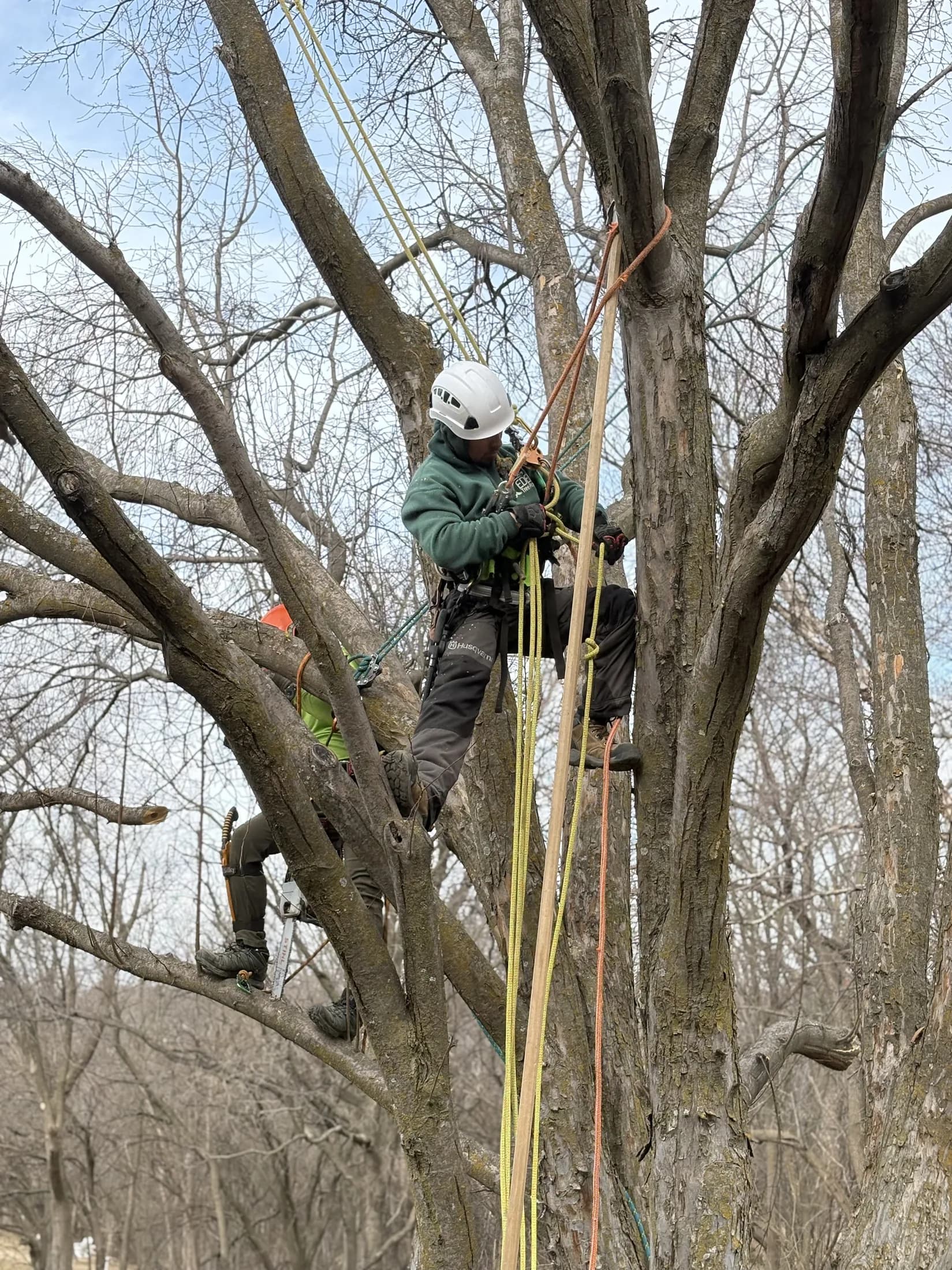
The same tree, left alone
Year one
A handful of blackened tips in the outer canopy. From the driveway the tree looks fine and nobody calls.
Year two
A wet bloom, and the strikes multiply. Last year's cankers start oozing and become the source for everything this spring.
Year three
The infection has walked into secondary limbs. Removing the dead wood now takes a real bite out of the canopy.
Year four
Cankers on scaffold limbs. Pruning to clean wood leaves a lopsided tree, and the choice narrows to living with it or replacing it.
Year five
The trunk is involved and the crown is half dead. A removal now, and any nearby pear or hawthorn has been taking inoculum from it all along.
Wood killed by fireblight does not recover. Every cut made later is a bigger cut than the one that would have worked the winter before.
The Dormant-Season Window for Pruning Out Fireblight
Pest and disease treatmentsOne year, December through November
Dormant, the only safe time to cut
December through March
Cold, dry, no bacterial movement, every canker visible on bare wood. This is when infected limbs come out.
Bloom, when infection happens
April into May
Open blossoms are the doorway. Protective applications, if used at all, are timed to bloom and warm wet weather, not to a date.
Shoot blight showing
Late May into June
The hooks appear now. Pruning them out immediately is tempting, and it is how the infection gets moved around a tree.
Growing season, tools stay out
July through September
Cuts into succulent summer wood are open doors. Heavy summer pruning and heavy nitrogen both make it worse.
Leaf drop and assessment
October and November
The leaves come off and the cankers become findable. Mark them now, cut in January.
One exception. A strike running toward the trunk of a young tree is worth cutting immediately, in dry weather, with sterilized tools. Waiting for January leaves nothing to save.
What Waiting to Prune Out Fireblight Really Costs
See pricing
Dormant pruning, checked each winter
Routine
An hour or two in the tree each January, cutting well below anything that blackened last season. The tree keeps its shape.
Cutting it out after it reaches the scaffolds
Bigger job, smaller tree
The same crew, more hours, and a canopy with holes that take years to fill. Sometimes a fair trade, sometimes not.
Removal and replanting
$1,000 – $8,000
Plus the years a replacement takes to flower the way the old one did. Every winter pruning visit is measured against this.
Removal figures are Eden's published range and vary with size and access. Pruning cost varies with tree size, how much canopy is involved, and the access needed.
“Michael and team did a wonderful job. The clean up was excellent, our tree covered three other yards, and the neighbors were also impressed with the clean up in their yards.”
Common questions about fireblight
Ask us something elseCan I just cut the black tips off now?
You can, and in a warm wet June you will probably spread it. The bacteria live in green wood beyond the visible edge, and a blade that touches infected tissue carries them to the next cut. If it must come out in season, cut in dry weather, far below the damage, sterilizing between cuts.
How far below the blackened wood do I cut?
Much farther than looks necessary. On a young shoot, at least eight to twelve inches below where the bark stops looking normal; on larger wood, back to a healthy union. Cutting an inch below the black leaves live bacteria in the stub.
Does a spray fix it?
No. Protective applications are aimed at open blossoms in warm wet weather and do nothing for wood already infected. On a landscape crabapple the pruning is the treatment. Anyone selling a summer spray to cure blackened limbs is selling a truck visit.
Will it spread to my other trees?
To other members of the rose family, yes. Apple, crabapple, pear, hawthorn, mountain ash, serviceberry and quince are hosts, and rain, wind and pollinators move it between them. Maples, oaks and evergreens are not at risk.
Should I fertilize the tree to help it recover?
Not with much nitrogen. It pushes soft, succulent shoots, which is what fireblight runs through fastest. A tree coming off a bad year is better served by water than by feeding.
Why did it explode this spring and not last spring?
Weather during bloom. Fireblight needs warmth and wetness on open flowers at once, and eastern Nebraska produces that some years and not others. Hail during or just after bloom opens wounds across the canopy, which is why some years look catastrophic on a tree that was fine for a decade.
Is there a crabapple that does not get this?
There are cultivars with real resistance, the most useful thing to know before replanting. If a tree has already been pruned into an ugly shape chasing this, a resistant selection beats five more years of winter surgery, and we say so even though the pruning is our work.
Identification is free, including when the answer is that the tree needs nothing.
Related Flowering Tree Symptoms and Services for Fireblight
All tree problems
Spotted leaves dropping in July
Apple scab, the other common problem on the same crabapples.
Apple Scab & Rust Treatment
What gets applied to a flowering tree, and when.
Tree Trimming & Pruning
The dormant cuts that actually control this, made to ANSI A300.
Pest & Disease Treatments
The full range, for a property with more than one thing going on.
Tree Planting
For when replacement beats surgery and the cultivar is the decision.
Why Fireblight Spreads on Pruning Tools, Not Just the Weather
Pest and disease treatmentsAlmost every tree problem here arrives on its own. Fireblight is the exception. It is a bacterium living in ooze on cankers and in the wood behind them, and it does not need weather to move from limb to limb if a homeowner with hand pruners will carry it. That is how a tree with four blighted tips in June ends up with fourteen in July.
So the discipline is simple and annoying. Cut in the cold, when the bacteria are not moving and every canker is visible on bare wood. Cut much farther below the damage than looks reasonable, into a union in wood that never looked wrong. Wipe the blades between every cut, not between every tree. If a strike is running for the trunk in summer, do it on a dry day the same way.
The part that costs us work is the replanting conversation. A crabapple pruned hard three years running to chase this is not a good-looking tree any more, and more pruning will not make it one. There are resistant cultivars that simply do not do this, and on a misshapen tree we will tell you replacement is the better spend rather than book another winter of surgery.