
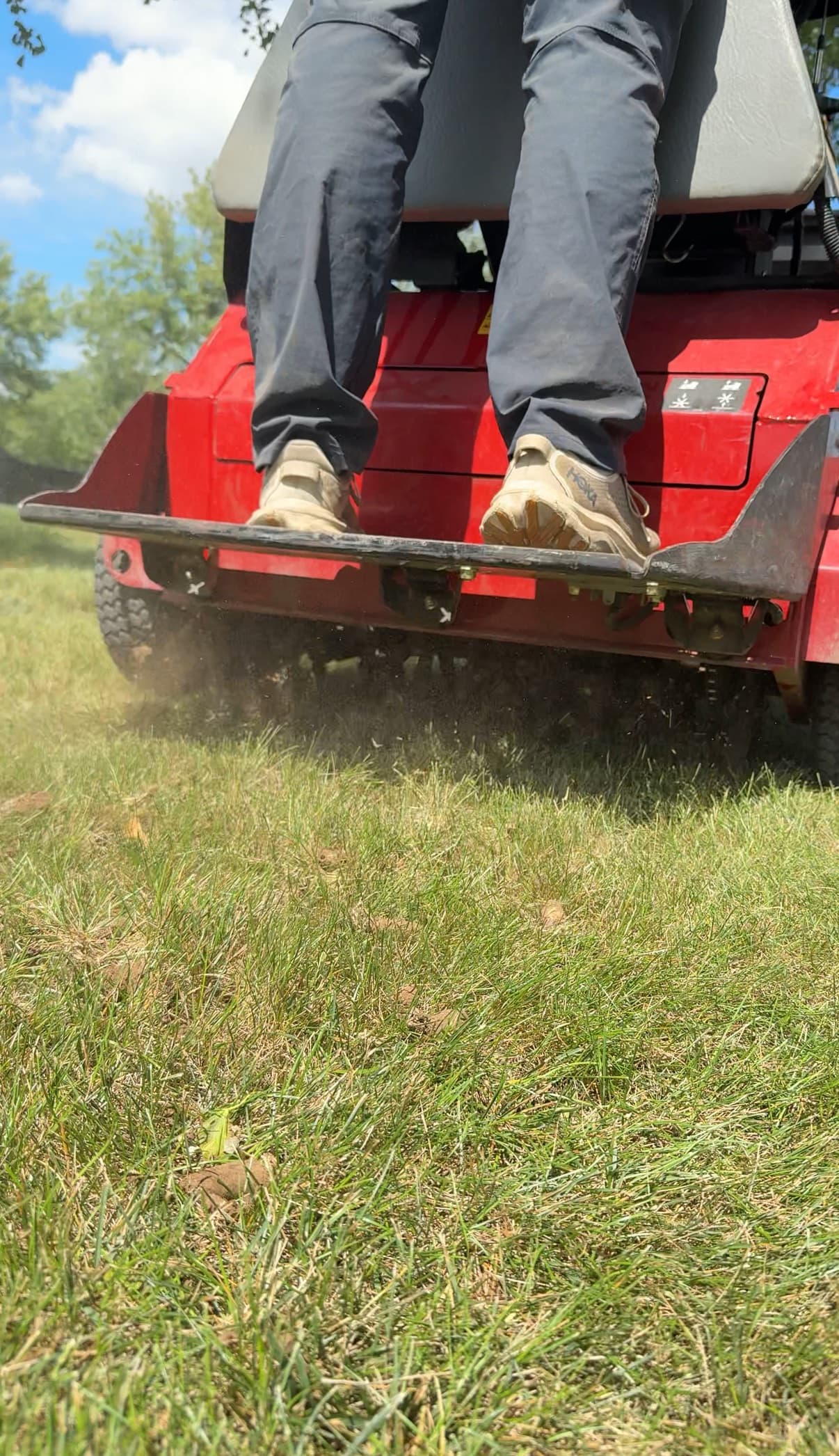
The damage
Turf that lifts like carpet
Grubs eat the roots, so the sod loses its anchor. If a patch peels back in your hand with nothing holding it down, that is the diagnosis.

By the time turf lifts like carpet in September, the useful application was due in June. This is a timing problem before it is a product problem.
The damage
Grubs eat the roots, so the sod loses its anchor. If a patch peels back in your hand with nothing holding it down, that is the diagnosis.

The tell
Skunks and raccoons tearing up a lawn are hunting. The digging is a symptom of what is under it.
The timing
The useful application goes on in early summer while the eggs are hatching, not in the fall when the damage finally shows.
Pull at a wilted patch. If it lifts away from the soil, call before you buy anything.
Drawn to proportion across one year
Eggs going into the soil
June into mid July
Adult beetles lay in moist, sunny turf and the eggs hatch into tiny grubs over the following weeks. A preventive product placed and watered in here is what a whole season of protection actually is.
Feeding, and the damage appears
August into September
Grubs are large, close to the surface and eating roots. This is when turf starts wilting in patches that water does not fix, and when animals start digging.
Down deep, out of reach
October to March
As soil cools they move well below the root zone to overwinter. Nothing applied to the surface reaches them and nothing needs to be.
Back up briefly, then gone
April into May
They feed a little near the surface before pupating into the adults that emerge in June. Spring treatment is possible and it is the least effective option of the year.
Egg-laying shifts with the summer. We schedule off beetle emergence rather than off a date.
Booked in spring, the application lands in the window. Booked in September, we are talking about repair.

Irregular patches that do not green up
Watering makes no difference, because the roots that would take the water are gone.
Sod that rolls back by hand
The definitive test. Grab a wilted edge and pull. Healthy turf resists; grub-damaged turf lifts.
Skunks, raccoons, moles working overnight
Torn turf and small conical holes. They are feeding on what is underneath.
Damage that shows in late summer
August into October is the window when it becomes visible, months after the eggs were laid.
Ten or more grubs per square foot
Below that, a healthy lawn generally carries them without visible damage.
Do the one-foot test yourself, then send us the count. That is a real diagnosis, free.
Worth treating preventively
Damage in a previous season
Beetles return to ground that suited them. Last year's damage is the best predictor there is.
Full sun and irrigation
Adults lay in warm, moist turf, and a well-watered sunny lawn in July is exactly that.
New sod or a young lawn
A shallow, still-establishing root system has far less to lose before it fails.
Neighbors with a history
Adults fly in. A street with a known problem is a street where prevention pays.
Reasonable to wait
No history, no symptoms
Most lawns in this metro carry a few grubs every year and never show a mark.
Shaded or unirrigated turf
Dry, shady ground is a poor place to lay eggs, and it usually stays a low-pressure site.
You would rather not treat
A legitimate position. We will show you the test so you can check it yourself in August.
Damage already done in fall
At that point the conversation is repair and seed, and prevention starts next June.
If your lawn has no history and no symptoms, we will show you the test rather than sell the program.
“Skunks had been digging the back lawn for two summers running. Treated in June and there has not been a hole since.”
A curative application can still be worth doing in late summer if the grubs are found while they are actively feeding near the surface. It works less reliably than prevention, because larger grubs are harder to kill and much of the root damage has already happened, and we will say which of those two you are buying.
The more useful conversation at that point is usually repair. Turf that has lost its roots is dead, and no insecticide brings it back. What brings it back is core aeration and overseeding, which happens to fall in exactly the same weeks the damage becomes visible. On a lot of properties the honest answer in September is to seed now and treat preventively next June.
That is also the moment to work out whether this is a recurring site. Beetles lay where conditions suit them, so a lawn that has been damaged once is a strong candidate for prevention every summer, while a lawn with no history is usually better served by watching it than by treating it.
The larvae of beetles, principally masked chafer and Japanese beetle in this metro. They hatch in mid to late summer and feed on grass roots in the top couple of inches of soil, which is why the turf above them dies in patches and lifts away when you pull it.
Preventively, in June into mid July, while the eggs are being laid and hatching. The product needs to be in the root zone and watered in before the grubs are large enough to do damage. A curative application in September can still help if the grubs are found early, and it is less reliable and often more expensive than getting the timing right.
Cut three sides of a one-foot square in a suspect area with a spade, peel the sod back like a flap, and count the white C-shaped larvae in the top two inches of soil. Fewer than about ten and a healthy lawn will carry them. Ten or more, especially with turf already lifting, and treatment is worth doing. Lay the flap back and water it and the lawn recovers.
They are hunting grubs, and they are usually right. Animal damage is one of the earliest reliable signs, often appearing before the turf itself starts to fail. Treating the grubs is what stops the digging; nothing you do to the skunks addresses the reason they are there.
Lightly damaged turf usually does, given water and a fall feeding. Where the roots are gone across a whole area, the sod is dead and it needs seed. That is why grub damage found in September often turns into an aeration and overseeding job, which is the same window and the right response.
No, and it is worth being clear about. Treating your turf reduces the grubs under your grass. The adults that strip a linden fly in from wherever they emerged, routinely several properties away, so the two problems are treated separately and neither substitutes for the other.
Fewer than ten in a square foot and we will tell you to leave it alone.

Where grub damage usually ends up: dead sod that needs seed rather than treatment.
The adults, on the trees. A different problem with a different window.

Feeding, weeds and insects on one schedule and one account.

%20(1).JPEG&w=3840&q=75)