

Spruce Losing Needles From the Bottom Up
Bare lower branches, thinning a whorl higher each year, purple-brown needles on the ground underneath. In this metro that pattern is nearly always needle cast, and the needles already gone are not coming back.
Free Estimate within 24 Hours
How to Tell Spruce Needle Cast From Look-Alike Evergreen Problems
Get it identified free
It is needle cast if
The pattern is bottom-up and year by year
The bare zone climbs
Lowest branches went first, the next whorl a year later. A photograph from two summers ago will show it lower than it is now.
Last year's needles drop, this year's stay
New growth at the branch tips looks fine into its second summer and then goes. That lag is the disease's signature.
There are black dots in rows
Along the length of a shed needle, visible with a hand lens. That is the fruiting body, and it is the confirmation.
The inner branches are bare but alive
Buds still swelling on wood with no needles on it means the branch is not dead and the tree is worth treating.
It is something else if
The pattern is anywhere but bottom-up
Whole branches died at once
Cytospora canker, which kills branches outright and often leaves a white resin bleed on the bark. A fungicide does nothing for it.
The tips died and the rest is fine
Tip blight, which works on the current year's candles rather than on two-year-old needles. Different fungus, different timing.
Needles are stippled and dusty
Spider mites. Tap a branch over white paper and look for moving specks. This is an insect problem on an entirely different schedule.
The whole tree browned at once
Root failure, drought, or a herbicide hit. Nothing sprayed on the canopy addresses what happened underground.
Where to Look for Spruce Needle Cast Before Spraying
Needle cast treatment
The lowest live whorl
Find the highest branch that is completely bare and the lowest one still holding needles. The gap between them is this year's front line.
Two-year-old needles
Count back from the tip. On a needle-cast spruce the tip growth is green and the growth behind it is gone.
The top third
Still full is good news and means the tree has enough canopy left to be worth the multi-year commitment.
The ground underneath
A carpet of shed needles with black dots in rows down them is the confirmation nobody needs a lab for.
Send a photo of the tree and one of the damage. An arborist will name it before anybody drives out.
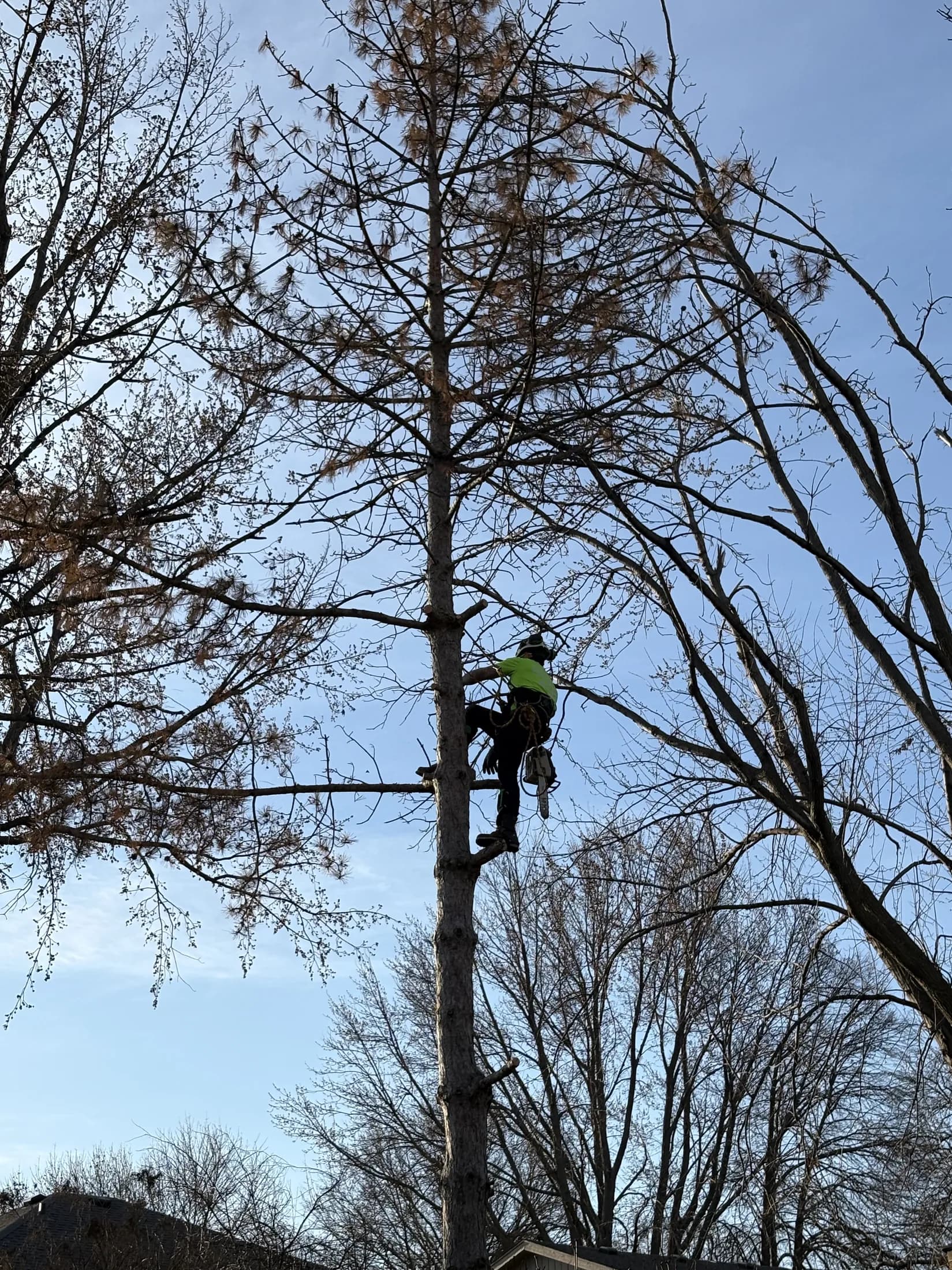
The same tree, left alone
Year one
The lowest branches are bare and everybody assumes it is shade from the branch above.
Year two
The bare zone is at eye level, the tree still reads as green from the street, and this is the last cheap moment to start.
Year three
Bare to head height and visible from the road. Treatment still works from here but the recovery is slower and the tree looks rough for longer.
Year four
More than half the canopy is gone. The tree is no longer doing the job it was planted for and the conversation starts shifting.
Year five
A bare trunk with a green tuft on top. Nothing brings this back, and the only remaining question is removal and what goes in its place.
Needles lost to this do not regrow on old wood. Everything a treatment protects is growth the tree has not made yet, which is the entire reason timing matters.
The Spring Spray Window for Treating Spruce Needle Cast
Needle cast treatmentOne year, March through February
Dormant, nothing to protect
March to mid April
Buds have not broken. There is no new tissue for a protectant to sit on and nothing useful to apply.
First application
New growth about half elongated
The single most important treatment of the year, timed to the candles rather than to a date.
Second application
Three to four weeks later
Covers the growth that elongated after the first spray. Two rounds is the standard program; one is half a program.
Infection happening, unseen
June through August
Spores are moving onto this year's needles right now. Nothing shows for a year, and nothing sprayed now changes it.
Nothing to do
September to February
Assessment and planning season. Anyone selling a needle-cast spray in October is selling you a truck visit.
Timing is read off the tree, not the calendar. Crews watch candle elongation, which moves by a week or two from one spring to the next.
What Waiting to Treat Spruce Needle Cast Really Costs
See pricing
Two sprays a year, caught early
Routine
A multi-year commitment on a tree that keeps its shape, keeps screening the road, and never enters the removal conversation.
Starting after half the canopy is gone
Same cost, worse tree
The same two rounds a year, protecting a tree that will look thin for a decade because the lost wood never refoliates.
Removal and replanting
$1,000 – $8,000
Plus the twenty years it takes a replacement spruce to do what the old one did. This is what every treatment is measured against.
Removal figures are Eden's published range and vary with size and access. Treatment cost varies with tree size and how many trees on the property are affected.
“Tyler was our crew foreman for a big tree removal project. He and his men did a wonderful job. They were courteous, on time, thorough, and did a good job cleaning up after themselves.”

Common questions about spruce needle cast
Ask us something elseWill the bare branches fill back in?
No, and this is the hard part of the answer. Spruce does not put new needles on old wood. What treatment protects is growth the tree has not made yet, so a treated spruce keeps everything from the treatment line upward and slowly grows past it. The bare lower branches stay bare.
How many years does treatment take?
Plan on three, and expect the first year to look like nothing happened. The disease works on a one-year lag, so the needles that drop the summer after your first spray were infected before you called us. Year two is when the difference shows.
Can you spray in the fall?
Not usefully. The protectant works on new growth in spring and it is gone long before fall. Anyone offering a needle-cast application in October is selling a visit rather than a treatment.
Which fungus is it?
Two are common on spruce here and they are treated on slightly different timing, which is why a needle gets looked at before anything is applied. Guessing between them is how a homeowner pays for a correctly applied spray at the wrong moment.
Is my neighbor's spruce infecting mine?
Very likely, in both directions. Spores move in wind and splashing rain over short distances. It is one of the reasons treating a whole street at once prices better and works better than treating one yard.
When is a spruce past saving?
Roughly when more than half the canopy is gone, or when the top has started to thin. At that point the tree cannot recover its shape in any timeframe that matters to the person looking at it, and we will say so rather than sell three years of spraying.
Should I plant another blue spruce?
Honestly, probably not. Colorado blue spruce is planted heavily here and struggles with our humidity, which is exactly why needle cast is so common. There are better choices for a Nebraska yard and we will walk you through them.
Identification is free, including when the answer is that the tree needs nothing.
Related Evergreen Problems and Services for Needle Cast
All tree problems
Pine candles dying back
Tip blight, the other common evergreen fungus in this metro.
Needle Cast Treatment
The service page: what gets applied, when, and over how many seasons.
Deep Root Fertilization
A stressed spruce holds less. Feeding is part of getting one through treatment.
Tree Planting
For when the honest answer is replacement, and the species choice matters.
Plant Health Care
The full treatment program, if the property has more than one thing going on.
Why Needle Cast Treatment Timing Matters More Than the Fungicide Itself
Needle cast treatmentThe single most useful thing to understand about needle cast is that the spray does not treat the disease. It is a protectant. It sits on new needles and stops spores landing on them from getting in. Applied to a needle that is already infected, it accomplishes precisely nothing, and the needle drops on schedule a year later while the homeowner concludes that treatment does not work.
That one-year lag is why this problem defeats so many people. Spores land on this spring's needles in June. Nothing visible happens. The following summer those needles turn purple-brown and fall, by which point the tree has already been reinfected twice more. Somebody who sprays in reaction to the drop is always treating the wrong year.
So the whole job is a calendar problem. Two applications, the first when the new candles are about half elongated and the second three to four weeks behind it, repeated for about three years while the tree grows past the damage. That is unglamorous and it is what actually works. It also means we will tell you in October to call back in April rather than book you a visit now, which costs us a job and is the only honest answer available.