

Sticky Sap Dripping From a Tree Onto Everything Below
A glaze on the windshield every morning, a patio that pulls at your shoes, black film over the leaves and furniture below. The tree is not bleeding. Something is feeding in it and passing the sugar through.
Free Estimate within 24 Hours
How to Tell Aphid Honeydew From Other Causes of Sticky Tree Sap
Get it identified free
It is aphid honeydew if
The stickiness is fine, even, and falls from the canopy
It coats everything under the drip line evenly
Cars, chairs, sidewalk, the tops of the hostas. Honeydew falls as a mist rather than running from one point.
The leaf undersides are crowded
Turn a leaf over. Aphids sit in dense colonies along the veins, soft-bodied and green or black, and do not scatter when disturbed.
Ants are running the trunk
Ants farm aphids for the honeydew and defend them. A two-way column up a linden in June is a tell before you look at a leaf.
It is worst in June and July
Populations build through spring, peak in early summer, and often collapse once heat and predators catch up.
It is something else if
The source is a trunk or another tree
It runs from a wet streak on the bark
Slime flux, or bacterial wetwood. It seeps from a wound, smells sour, and stains the bark in a vertical line. No spray fixes it; most trees live with it.
There are hard bumps on the twigs
Scale insects, which make the same mess. They look like bumps rather than insects, and run on a different calendar.
Your tree is clean and the mess is not
Honeydew drifts. A linden two properties upwind can glaze your car while your maple is clean. Check what is overhead before treating.
The leaves are stippled, not sticky
Spider mites, which empty leaf cells without excreting sugar. Dusty, bronzed foliage and no tackiness.
Where to Look for Aphid Honeydew Before Treating a Tree
Aphid control
The underside of a low leaf
The whole diagnosis. Colonies sit under the leaf, which is why people stare at a sticky tree and find nothing.
White flecks in the colony
Cast skins, shed as aphids molt. The colony has been reproducing, not blown in this week.
Tan, swollen aphids that do not move
Parasitized mummies. Wasps are working the colony, which usually means it is about to crash without us.
Black film on the leaves
Sooty mold growing on the honeydew. It sits on the leaf rather than infecting it, and goes when the honeydew stops.
Send a photo of the tree and one of the damage. An arborist will name it before anybody drives out.
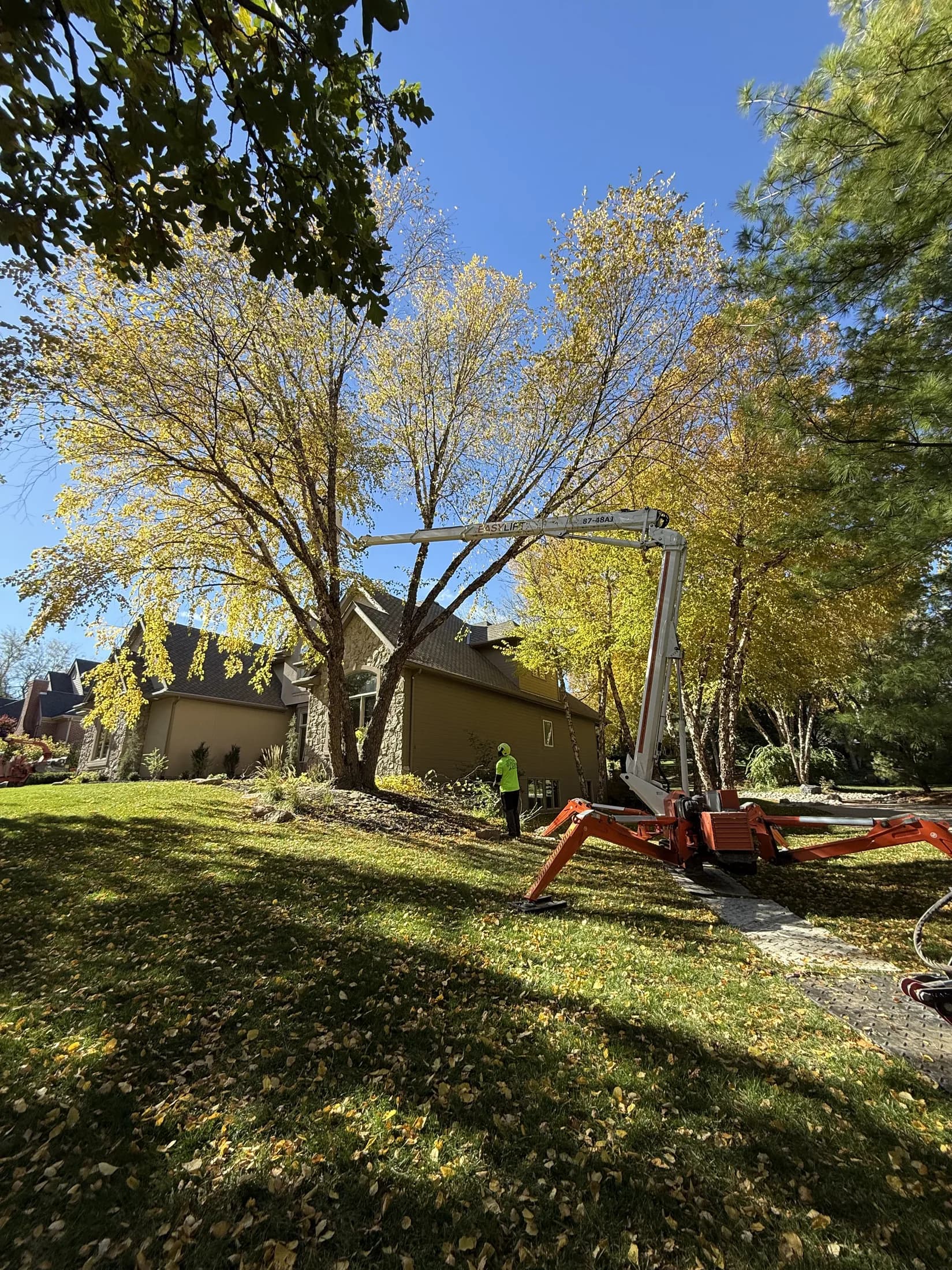
The same linden, left alone
Late May
The first colonies establish on new growth. Nothing visible from the ground, nothing dripping yet.
June
The windshield is glazed every morning. This is the week almost everyone calls, and the week treatment does the most good.
Early July
Peak. The patio is tacky, the furniture unusable, and black film is showing on the leaves and the car paint.
Late July
Lady beetles, lacewings and parasitic wasps find the colony and it falls hard. In many summers the dripping stops here on its own.
August into fall
Dripping over, sooty mold weathering off, no lasting damage. The residue on car and concrete stays until somebody washes it.
The damage from a heavy aphid year is almost entirely to your patio furniture. Established shade trees carry these populations without measurable harm.
The Best Time of Year to Treat Aphids and Stop Honeydew
Aphid controlOne year, November through October
Eggs on the twigs
November to March
Dormant horticultural oil smothers overwintering eggs on a repeat offender. Cheap, low impact, on before the buds swell.
Hatch and early build
April into May
Small colonies on new growth. The best moment for anything systemic, with time to move before the tree flowers.
Linden in flower
Late May into June
Nothing systemic goes on a flowering linden. Those flowers are one of the heaviest bee draws here, so we schedule around bloom or decline the job.
Peak honeydew
June through August
Reactive treatment knocks a colony down within days. It does not clean up what fell, and predators often would have handled it.
Collapse and return flight
September and October
Populations are gone or leaving for winter hosts. Nothing to treat in fall.
Aphid years are not equal. A cool spring makes a heavy season and a hot early summer ends one fast, which is why the same tree drips two months one year and two weeks the next.
What Treating (or Not Treating) Aphid Honeydew Really Costs
See pricing
Park somewhere else and wait it out
Nothing
Move the car, hose the patio, let the predators finish. On a healthy tree with nobody sitting under it, this costs nothing and the tree is unharmed.
One well-timed treatment
Routine
Worth it when the tree stands over a driveway, deck or play area used in July. Timed before bloom where flowers matter to bees.
Removal and replanting
$1,000 – $8,000
Occasionally the answer when a large linden sits over a driveway and the mess repeats. A siting decision, not a health one, and we say so first.
The removal figure is Eden's published range and varies with size and access. Taking down a healthy shade tree over honeydew is rarely what we recommend.
“Eden Tree Pros were just the best to work with. They were very timely. The guys worked very hard while they were here and very professional. I'm so glad I found them and I will always use them whenever the need arises.”
Common questions about sticky honeydew from trees
Ask us something elseIs the honeydew hurting my tree?
In nearly every case, no. Aphids remove sap from a tree that has plenty to spare, and an established maple or linden carries a heavy population with no measurable loss of growth. The exception is a young or stressed tree with limited foliage.
What is the black stuff growing on it?
Sooty mold, fungi that live on the honeydew rather than the plant. It does not infect leaf tissue, though a heavy coating shades the leaf enough to cost a little photosynthesis. It weathers off once the honeydew stops.
Will it come off my car?
Yes, if you get to it. Fresh honeydew washes off with soap and water; sooty mold baked onto paint for a month is far harder and can etch clear coat. Wash weekly during the drip rather than waiting.
Can you just spray the tree?
We can, and on a small ornamental it often works in days. On a full-size shade tree, covering the canopy interior well enough to reach the colonies is difficult, and a poor cover kills lady beetles and lacewings more reliably than aphids. That is the honest limit of a contact spray.
Why did the dripping stop by itself?
Predators and heat. Lady beetles, lacewing larvae and parasitic wasps build up on the colony and often crash it within weeks, and aphids reproduce poorly in a hot Nebraska July. That is why we ask how long it has been dripping before quoting.
Which trees do this worst here?
Linden generates the most calls here, followed by silver and Norway maple, birch, honeylocust and willow. Any can run clean for years and then have a bad season.
Is there anything I should not do?
Do not have the tree topped or heavily pruned to fix this. Hard pruning forces soft new growth, which is exactly what aphids feed on, so you trade one sticky summer for several. If the tree needs pruning, prune it for structure on its own schedule.
Identification is free, including when the answer is that the tree needs nothing.
Related Pest Symptoms and Services for Aphid Honeydew
All tree problems
Aphid Control
What gets used, when, and when we tell you to skip it.
White powder across the leaves
The other coating on the same trees, and its different answer.
Yellow leaves with green veins
If leaves are pale as well as sticky, there is a soil problem too.
Tree Trimming
Structural pruning on its own schedule, not a reaction to a pest.
Annual Tree & Shrub Program
Visits that catch a repeat aphid tree in April, not June.
Why Aphid Honeydew Is a Mess Problem, Not a Tree Health Problem
Aphid controlAphids tap the phloem, the tissue carrying sugar down from the leaves. That fluid is under pressure and far richer than the insect needs, so most of it passes straight through as honeydew. What lands on your car is not sap and did not come from a wound. It came out of an insect, in quantity, from a colony forty feet above your head.
That is why the mess and the medical situation are so badly matched. A colony large enough to glaze a driveway every night removes a trivial fraction of what a mature linden makes in a day, and the tree finishes the season with normal growth and fall color. The homeowner, meanwhile, has a patio nobody can sit on. Treating that is a comfort decision, not a health one.
So the question we ask on the estimate is what is underneath. A linden over a lawn nobody walks on gets left alone, because natural enemies usually end it in weeks and a broad spray would kill them first. A linden over the driveway, the deck and the kids' table gets treated, timed around bloom, because linden flowers are one of the biggest bee draws in the metro. Neither answer is more professional.