Eden Tree Pros, tree service in Omaha, Nebraska
Dense mature canopy before thinning in the Omaha metro

Crown Thinning in Omaha, NE

A thinned crown lets July wind pass through instead of slamming in, and lets light reach the grass dying underneath. The skill is in which branches leave — and in knowing the interior is not the place to take them from.

Free Estimate within 24 Hours

4.9across 313+ reviews on

When Crown Thinning Is the Answer: Three Problems a Thinner Crown Solves

Dense shade tree dominating a residential yard in the Omaha metro

The wind problem

A crown so dense it fights every storm

Some maples and lindens here build canopies you cannot see daylight through, and in a straight-line wind that density is a wall. Thinning opens paths for air — often the difference between losing leaves and losing limbs.

Understory plants struggling beneath a dense canopy in the Omaha metro

The shade problem

Grass and gardens starving underneath

When the lawn under a tree has thinned to dirt and moss, the fix is not always removal. Taking the right branches turns deep shade dappled — enough for turf to hold on — while the tree keeps nearly all its canopy.

Crossing and deteriorating branches inside a tree crown in the Omaha metro

The housekeeping

Deadwood and branches wearing each other out

Every thinning starts with the wood that should not be there anyway: dead limbs over the patio, and crossing branches rubbing wounds that decay walks into. That alone transforms most neglected crowns.

Wondering if your tree is too thick or just looks it? A photo from underneath usually tells us.

How Crown Thinning Works: The Interior Stays, That's the Whole Trick

How every job runs
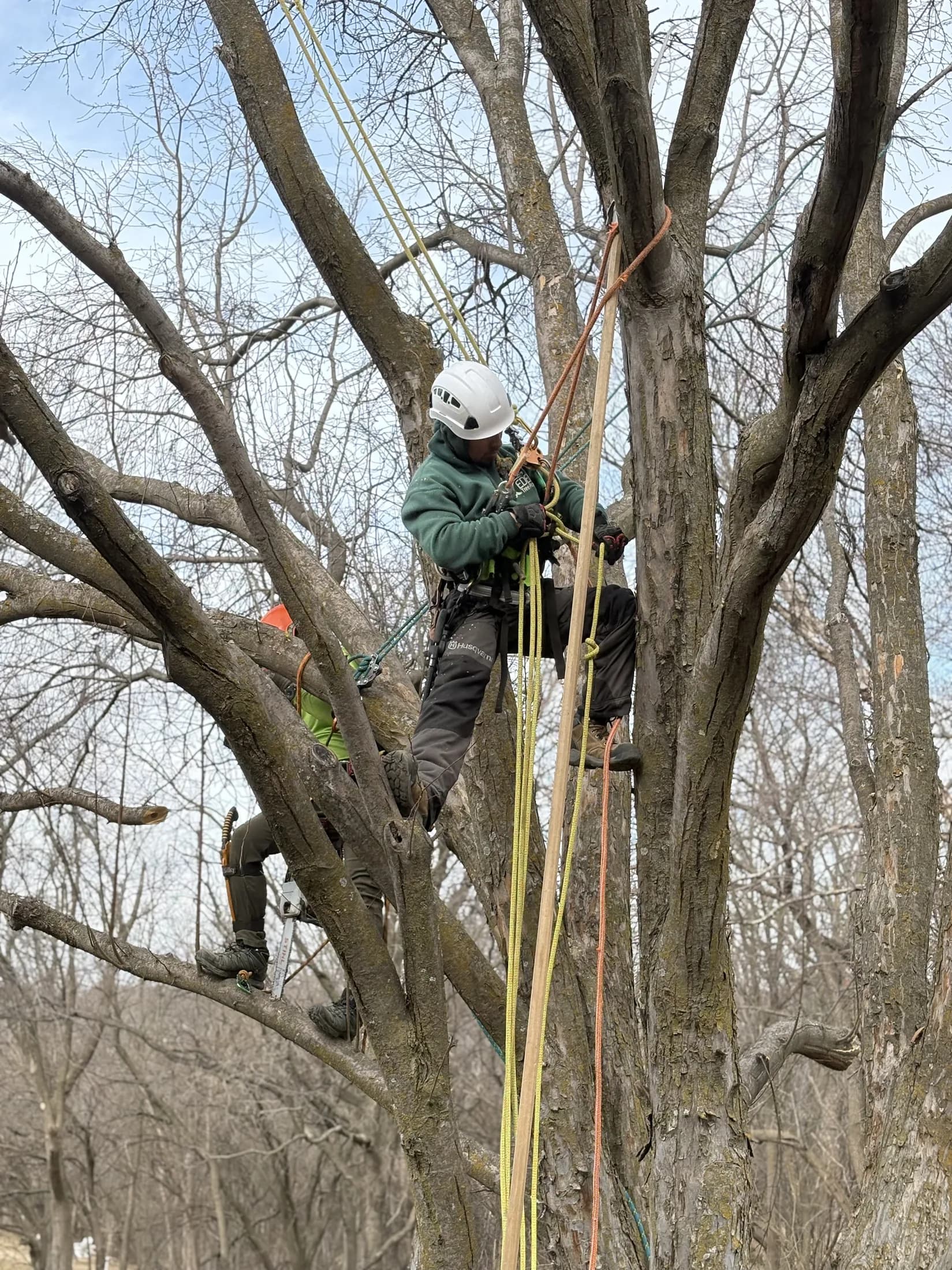
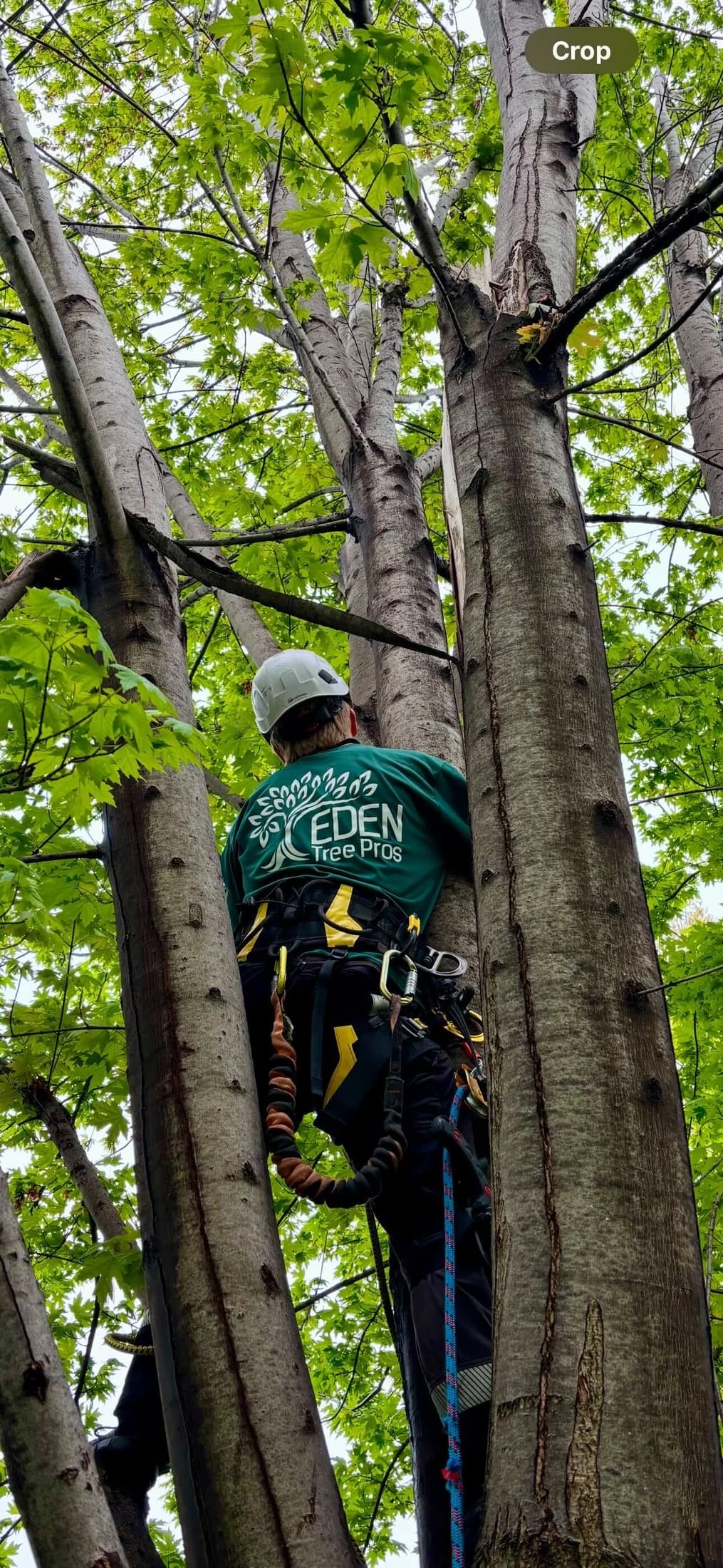
Eden Tree Pros climber thinning a canopy selectively in the Omaha metro

Branch by branch

How a thinning actually gets done

Deadwood comes out first

Dead limbs are the free win: removing them costs the tree nothing, drops real hazard, and often accounts for most of what needed to leave.

Crossing and rubbing branches are resolved

Where two branches wear through each other's bark, one is chosen and the other removed at the collar — while the wound is the smaller of the two futures.

Live cuts are spread through the crown

What live wood comes out is taken evenly — outer crown included, interior respected — so density drops without holes and limbs keep their foliage.

Lion-tailing never happens

Stripping the inner branches and leaving tufts at the tips is a named malpractice, not a style. It moves the load to the limb ends — exactly where you do not want it.

The total stays under the quarter

About a quarter of the live canopy in one season is a hard ceiling here, and on most mature trees the right amount is well under it.

Crown Thinning Cost: What Thinning Costs, Next to What Neglect Does

See pricing
Mature shade tree standing over a home in the Omaha metro

Thinning on a sensible cycle

A crew visit every few years

Deadwood out, defects resolved, density managed. Each visit is smaller and cheaper than the first — the crown never gets away from you again.

Over-thinning, bought by the pound

Looks dramatic, costs the tree

Crews that sell by the size of the brush pile strip interiors and blow past the quarter limit. The tree answers with stress growth and sunscald — worse in three years.

Never touching a dense, defect-filled crown

$1,000 – $8,000 when it fails

The rubbing branch becomes the decayed branch, the dense crown becomes the sail, and a storm turns deferred trimming into a removal at our published range.

No two crowns carry the same deadwood and defect. The free estimate names what should come out and what it costs, in writing.

Crown Thinning Scope: What's Included, and What's Not

In every thinning

An arborist deciding which branches leave, not a ground crew guessing

Deadwood removal throughout the crown, not just where it is easy to reach

Crossing and rubbing branches resolved at the collar — ANSI A300 cuts throughout

Live-canopy removal held under the quarter-per-season limit

An even result: no stripped interior, no holes, no tufted limb ends

Brush chipped, wood hauled, the lawn raked before we leave

Separate, or not ours

Lion-tailing, however asked for — 'clean out all the inside branches' gets a respectful no and an explanation

Height or spread reduction — its own service with its own cuts; see crown reduction

Treating the diseases a thinning sometimes uncovers — diagnosis and treatment are quoted separately

Thinning a tree that mostly needs deadwooding — we quote the smaller job when the smaller job is right

Which branches leave, and why, is explained at the estimate — before the saw hears of it.

4.9
We have always used Eden Tree Pros for all of our tree trimming needs, and for iron treatments for our birch tree. We won't use anyone else. They have earned our trust.
Tess CramerOmaha Metro313+ reviews

Crown Thinning FAQs: Lion-Tailing, Storms and Regrowth Questions

Ask us something else

How much of the tree do you remove in a thinning?

Never more than about a quarter of the live canopy in a season — the standard rule, not our invention — and usually well under it. Much of what leaves a typical crown is deadwood, which does not count against the tree at all.

What is lion-tailing, and why does it keep coming up?

Stripping the interior branches off a limb and leaving a tuft at the end. It is common because interior wood is easy to cut, and malpractice because it moves the load to the limb tips — the position most likely to snap. A bid promising to 'clean out the inside of the tree' is describing exactly this.

Will thinning make my tree safer in storms?

It helps, measurably: wind passes through instead of loading the crown like a sail, and the branches most likely to fail are gone. It is not a guarantee — no pruning is — and a tree with a structural defect may also need cabling or reduction, which we will say plainly at the estimate.

Will grass really grow back under the tree?

Often, if deep shade was the problem — thinning turns it dappled, and turf can live with dappled. Under a Norway maple, though, shallow roots steal water as fast as the shade steals light. When we think seeding will fail, we will tell you before you spend on it.

How often does a tree need thinning?

Every few years for a mature shade tree here, and the visits get smaller each time. Annual thinning is almost always too much — a tree that needs live wood removed every year is being over-pruned, not maintained.

When is the best season for it?

Dormant season for most species — structure is visible and the tree closes wounds in spring. Oaks only in the cold months, because of oak wilt. Deadwood can and should come out whenever it is found.

Can you just top it instead? It would be cheaper.

No. Topping is the one cut we refuse site-wide, on every species, at any price — it creates weak regrowth and decay we end up removing as a hazard years later. If a crown is dense, thinning fixes it. If a tree is too tall, reduction fixes what can be fixed. Topping fixes nothing.

Free and no pressure

Every estimate is free and comes in writing before anything is booked.

Why Restraint Is the Product in Crown Thinning: The Best Job Is the One You Have to Look Twice to Notice

All tree trimming

Thinning is the easiest pruning service to do badly, because the bad version photographs well. A huge brush pile looks like value; a properly thinned crown looks, from the street, like nothing happened. The tree tells the truth later: lion-tailed limbs snap in the storms they were supposedly prepared for, while an evenly thinned crown flexes and keeps its wood.

The quarter rule is our restraint in writing: no more than about a quarter of the live canopy in a season, usually much less. A tree's leaves are its income; take too many and it answers with stress shoots and borrowed reserves, and Omaha's summers collect that debt in sunscald and dieback. Any crew willing to exceed the quarter because you are already paying is spending your tree to pad an invoice.

Here is the part that costs us: a fair number of thinning estimates end with us recommending less than the caller wanted to buy. Sometimes the crown mostly needs deadwooding — a smaller job than we were invited to quote. Sometimes it needs nothing but patience. Since 1997 we have stayed hired in the same neighborhoods by quoting the tree's needs rather than the caller's budget, and letting the difference walk when it has to.

Get an honest read on your crown, free

Call nowFree estimate